 The New Experience Newspapers Online News Indepth, Analysis and More
OYETOLA PUSHES FOR JOINT ACTION WITH STATES AND INVESTORS TO GROW NIGERIA’S BLUE ECONOMY
Diri Urges Coastal States to Take Ownership of Maritime Opportunities
The Federal Government is seeking deeper collaboration with state governments, private investors and development partners to fast-track the rollout of Nigeria’s National Policy on Marine and Blue Economy. The Minister of Marine and Blue Economy, Dr Adegboyega Oyetola, said sub-national involvement is essential to translating the policy into tangible economic outcomes for coastal and inland communities.
Speaking on Thursday at the Second Quarter 2026 Citizens’ and Stakeholders’ Engagement in Lagos, Oyetola noted that Nigeria had completed the policy design phase and must now concentrate on implementation. The forum, held at Eko Hotel and Suites, Victoria Island, was themed “From Policy to Action: Mobilising Sub-National Governments for Effective Implementation of Nigeria’s National Policy on Marine and Blue Economy.” It drew participants from government, the diplomatic community, development agencies, academia, industry, and several state delegations.
The minister said the policy provides a roadmap for unlocking value from Nigeria’s oceans, inland waterways, fisheries, and coastal assets. However, he argued that impact will depend on coordinated efforts across federal, state and community levels. According to him, most of the country’s blue economy resources are domiciled within states, which positions governors and local authorities as critical drivers of investment, employment, food security, and environmental protection.
Oyetola said reforms under President Bola Ahmed Tinubu’s Renewed Hope Agenda have improved stakeholder coordination, attracted fresh capital, enhanced maritime safety and raised the profile of Nigeria’s seaports. He referenced the 2025 Container Port Performance Index published by the World Bank and S&P Global Market Intelligence, which listed Tin Can Island Port as the world’s tenth most improved port and Lagos Port Complex, Apapa, as twelfth most improved between 2020 and 2025. He added that ongoing modernisation, alongside planned deep seaports in Akwa Ibom, Bayelsa, Cross River, Lagos and Ondo, will reinforce Nigeria’s ambition to be West Africa’s leading maritime hub.
He also said stronger port performance has supported a consistent national trade surplus since 2024. On waterway safety, the minister said the ministry has stepped up collaboration with agencies and states, rolled out life jacket distribution nationwide, and is urging coastal governments to phase out unsafe wooden passenger boats in favour of modern fibre boats. He further called on states to align their blue economy plans with the national framework and to create room for private capital in fisheries, aquaculture, maritime transport, tourism, shipbuilding, renewable energy and marine biotechnology.
In his keynote, Bayelsa State Governor, Senator Duoye Diri, described the creation of the Federal Ministry of Marine and Blue Economy as a strategic move to diversify Nigeria’s economy. He said Bayelsa responded by establishing a state Ministry of Marine and Blue Economy in June 2024 to advance the maritime component of its A-S-U-R-E-D Prosperity Agenda.
Diri disclosed that the state has started large-scale fish production at the Bayelsa Aquaculture Village in Yenegwe, where a hatchery is producing high-quality catfish fingerlings and juveniles to improve food security and generate jobs. He added that Bayelsa has increased its marine transport capacity and is pushing ahead with the proposed Agge Deep Seaport, which he described as a future gateway for the Niger Delta.
The governor outlined five priorities for coastal states seeking to benefit from the blue economy: setting up dedicated ministries, passing enabling laws, mapping and securing maritime areas, investing in reliable data systems, and building skills, markets, innovation centres and logistics infrastructure.
Speaking on behalf of Dangote Industries Limited, Managing Director of Dangote Port Operations, Simeon Akin Omole, said private sector commitment will determine the success of the national policy. He noted that the policy aims to create three million jobs in its first four years, deliver seven per cent annual sector growth, and reserve at least half of new roles for young people aged 18 to 35.
Omole said industrial progress requires policy stability, sound infrastructure, finance and investor confidence. He identified three enablers: infrastructure-led industrialisation, value-chain expansion, and stronger public-private partnerships. He said approvals for new deep seaports will support industrial clusters covering agro-processing, petrochemicals, shipbuilding, cold-chain logistics and maritime technology, thereby boosting Nigeria’s competitiveness.
He also pointed to fisheries as a major opportunity. Despite higher domestic output, Nigeria still imports nearly one billion dollars’ worth of fish each year due to supply gaps. He said investment in aquaculture, hatcheries, feed, processing, cold storage and export systems could cut imports, save foreign exchange, create over 500,000 jobs, and position Nigeria as a fisheries exporter.
Omole added that public-private partnerships must evolve into strategic alliances involving government, investors, research bodies and coastal communities. He said industrial clusters linked to modern ports, Special Economic Zones and digital infrastructure will attract long-term capital and accelerate growth.
The engagement also featured goodwill remarks from Akwa Ibom Deputy Governor, Senator Akon Eyakenyi, Senate Committee Chairman on Marine Transport, Senator Wasiu Sanni Eshinlokun, representatives of Ondo and Borno states, and several private sector stakeholders. All pledged to support the coordinated implementation of Nigeria’s marine and blue economy agenda.
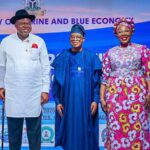
CAPTION
L-: Bayelsa State Governor, Senator Duoye Diri; Minister of Marine and Blue Economy, Dr Adegboyega Oyetola, and Deputy Governor of Akwa Ibom State, Senator (Dr) Akon Eyakenyi, at the Second Quarter 2026 Citizens’ and Stakeholders’ Engagement of the Federal Ministry of Marine and Blue Economy held at Eko Hotel and Suites, Victoria Island, Lagos, on Thursday.
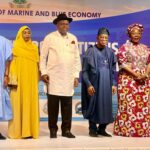 CAPTION
L-R: Chairman, Senate Committee on Marine Transport, Senator Wasiu Sanni Eshinlokun; Permanent Secretary, Federal Ministry of Marine and Blue Economy; Mrs. Fatima Mahmood; Executive Governor of Bayelsa State, Senator Douye Diri; Minister of Marine and Blue Economy; Dr. Adeboyega Oyetola; Deputy Governor of Akwa Ibom State; Senator (Dr.) Akon Eyakenyi and Director General, Nigerian Maritime Administration and Safety Agency, Dr Dayo Mobereola, at the Second Quarter 2026 Citizens’ and Stakeholders’ Engagement of the Federal Ministry of Marine and Blue Economy held at Eko Hotel and Suites, Victoria Island, Lagos on Thursday.
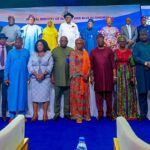 CAPTION
Bayelsa State Governor, Senator Duoye Diri; Minister of Marine and Blue Economy, Dr Adegboyega Oyetola; Deputy Governor of Akwa Ibom State, Senator (Dr) Akon Eyakenyi, and others at the Second Quarter 2026 Citizens’ and Stakeholders’ Engagement of the Federal Ministry of Marine and Blue Economy held at Eko Hotel and Suites, Victoria Island, Lagos on Thursday.